Matsue city in Shimane Prefecture is famous for Wagashi in Japan. We thought that we want people in other countries to know more about this traditional Japanese culture of Wagashi, so we made this blog as part of our graduation project course.
We hope that this blog provides a good opportunity to attract your interest in not only Wagashi but also in Matsue and Japan.
In this blog, we introduce Wagashi that we found in Matsue, in the hopes that it will become more widely known and enjoyed.
I think that it represents a reflection of orange leaves in the stream.
The name "Aki no kawa" means "Stream of Autumn" in English.
It has a lovely orange gradation on the outside.
A colored leaf is very cute. This color is orange and yellow. Thin pieces of clear and orange agar are laid on top of the wagashi to represent a stream.
This black part means a rock. This is made by bean jam.
The texture of this wagashi is smooth inside with a chewy layer of mochi on the outside. This wagashi has no fragrance.
Taste of bean jam is strong. Agar is sweet.
This wagashi is delicious!!! Please eat, everyone!!!!!
We ate one
of the wagashi for autumn, Kuri-Kinton made by Keigetu-Dou in Matsue, Japan. We’ll describe it according to the five senses.
*Appearance
Its color is light brown and it looks like a chestnut. There is a maple leaf that
has a beautiful gradation, from orange to yellow on the top! If you look closely at the picture you can see some black areas on top of the wagashi. This was probably done with a kitchen torch to add interest.
*Sound of the Name
This
is named from a Japanese foods, Kuri-Kinton.
Let
me explain differences between two Kuri-Kintons.
Kuri-Kinton(栗金団)is one of the foods in Osechi.
Osechi are the traditional Japanese foods that are eaten from the first day of the new year. Its color is gold or yellow and represents money. Kuri-Kinton
is usually very sweet.
But, This wagashi, Kuri-Kinton(栗きんとん) is a different one. This
Kuri-Kinton is less sweet than Kuri-Kinton(栗金団). And its shape, like a chestnut, is made with Chakin-Shibori (squeezing in a tea napkin).
*Touch
The texture of this wagashi is moist, creamy and soft.
*Smell
This wagashi has a light chestnut aroma.
*Taste
It has a rich chestnut taste. It
has only light brown bean paste that taste like chestnuts.
This wagashi has chestnuts and sugar but
it isn't so sweet.
“Soba Joyo”
This wagashi (Japanese sweet) is a manju (Steamed bun) made with
buckwheat flour.
Koshian (strained sweet red bean paste) is inside the outer steamed bun made from sobako (buckwheat flour).
It has a nice buckwheat fragrance and when you eat it, you will be able to taste the mild and earthy flavor of buckwheat.
The bean paste inside isn’t very sweet, so it has a
simple and delicious taste.
There are roasted buckwheat kernels on
manju.
I think Soba joyo is a refined wagashi.
Saiun-Do ~The interview from Mr.Yamaguchi~
We visited Mr. Yamaguchi who works at Saiun-Do to learn more about
Japanese sweets, called “Wagashi” as part of our graduation seminar course for our university.
“Sain-Do” is a long-established wagashi shop which was founded in 1874. It's main shop is in Matsue
city, Shimane Prefecture.
We talked with him in a Japanese-style tea room
on the second floor of the main shop.
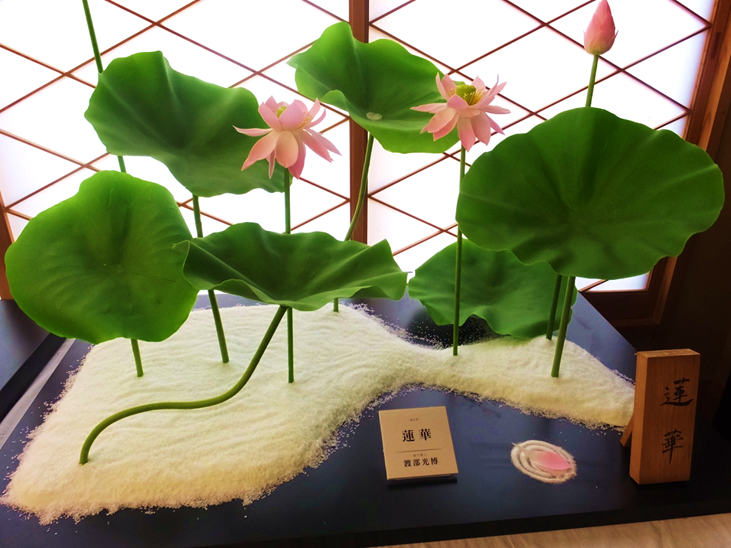
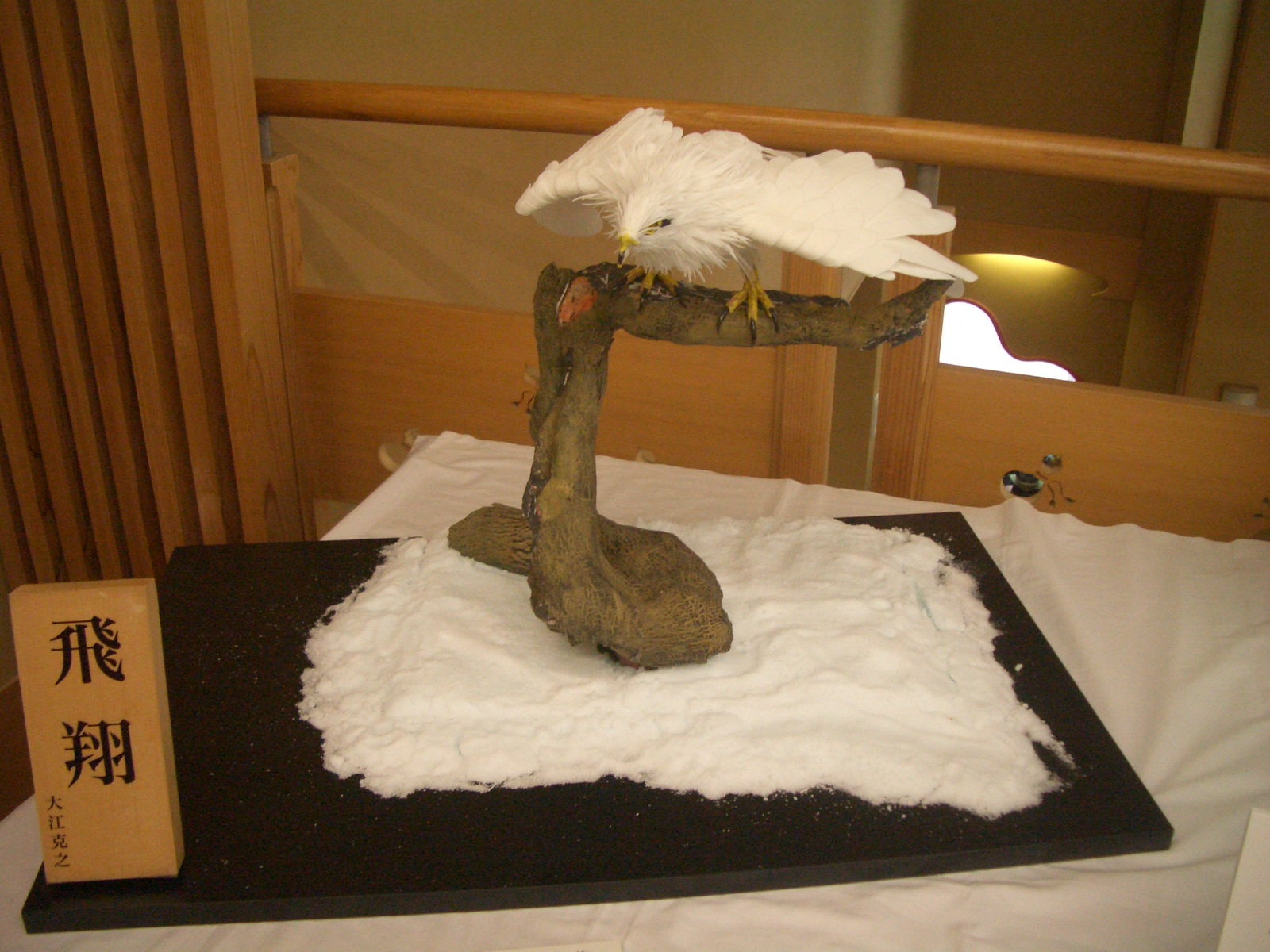
After coming up the stairs, we were captivated by the many big wagashi art objects sculpted in
imitation of such things as wild birds, peony, waterwheel scenery of the countryside, and the ancient Izumo
Taisha Shrine.
The thatched roof and flowing water of the water wheel were crafted finely
in detail and it was hard to believe they were all made from sugar.
Students admire the confection sculptures
Lotus Blossoms
Japanese Red Maple
We entered the Japanese-style tea room after we finished
looking around. There we ate wagashi which we selected and matcha or powdered green tea. Mr. Yamaguchi
came in after a few minutes and told various things about wagashi. Below are images of the wagashi we selected. We came in the summer so these seasonal wagashi were offered on the menu.
According to Mr. Yamaguchi, we can enjoy wagashi with our five senses.
1: Hearing2:Sight3:Sense of smell4:Touch5:Taste
Hearing is hearing the sound of name of the Wagashi and getting an
image of the situation or particular image that the wagashi represents.
Sight is seeing the wagashi from various angles and relating it to
the image. Much care is taken to make wagashi beautiful and unique.
Sense of smell is enjoying the subtle fragrance of the wagashi. It is subtle so that it won't interfere with the matcha that is drunk with it.
Touch is feeling the wagashi when you pick it up with your fingers or cut it into pieces. wagashi are usually cut with a “Kuroyozi (a thick and slightly sharpened stick for eating wagashi)”. Also, the texture or mouth-feel of the wagashi is enjoyable.
Taste is tasting the wagashi deliciously while keeping in mind the seasonal image. Wagashi are generally not overly sweet. However, some sweetness is important to balance the bitterness of the matcha.
Doesn't this sound interesting!
He told us about the order to eat and drink matcha and wagashi. When we drink
bitter powdered green tea after eating sweet wagashi, we don’t mind the
bitterness of the matcha. It’s such a delicious combination.
Also, we understood that the climate of Japan is related
to the background of wagashi. Mr. Yamaguchi told us that
moist air and the four seasons which may be unusual in other areas are very important for wagashi.
High humidity is necessary to make delicious wagashi and preserve it. The four
seasons are indispensable because wagashi attempt to express the beauty of nature.
In addition, we learned about Saiun-Do's efforts to promote wagashi overseas. They have held events featuring wagashi in the United States and France
and they seem to be working hard to share wagashi with many people!
But it
was hard to make and preserve wagashi in those countries because of the dry local climate which didn’t match Japan's. Also,
perhaps it wasn’t easy for people there to understand the Japanese images of birds or scenery used to represent the seasons. So they seemed to have trouble appreciating wagashi. However, there are
some people who said, “These are so good” and the activity was featured in the
local newspapers.
Mr. Yamaguchi said “We will continue to do our best and hope others enjoy our wagashi.” We students felt more attracted to wagashi after this
visit. We thought that our appreciation for wagashi should spread to many people
(not only Japanese people but also foreign people.)
Thank you Saiun-Do for welcoming us so kindly and teaching us more about the wagashi in Matsue!
Origin
: This wagashi is said to be loved by Tengu (It’s a Japanese monster who has red
skin and long nose) living on Daisen, the famous mountain in Tottori
prefecture. It’s also said, Houkibou was made for the cerebration of
Saiundou opening in Yonago city, Tottori prefecture, in 1960.
Appearance
: It’s almost a circle and is shaped like a fan. It’s the Tengu’s fan, I think. It's color is
brown because it’s made of azuki beans, but it has a little white on the outside because of the sugar crust.
Texture
: The outside was harder than I thought, and the sugar crust made it a little crispy and crunchy. Inside, it has a Gyuhi (like a soft rice cake), so
it wassoft and chewy inside.
Smell
: I detected the smell of azuki, it was a sweet smell. But I didn’t notice any other smells.
I
thought I couldn’t eat it without Matcha (powdered green tea), because it was so sweet. But, I
liked the Gyuhi, inside it. If you like azuki, you’ll like it very much. I
really recommend eating Houkibou with Matcha.
Wakakusa is one of thethree most famous Wagashi in Matsue city. It was named by Lord Matsudaira Fumai (1751-1818), who was the leader of the Matsue Clan and made Matsue famous for Wagashi. He is know as a person of culture and a success as a Chajin-茶人- (the person who is a professional of tea ceremony and loves tea). His ability as a Chajin (茶人) was first-class. He made written records of some of his favorite Wagashi which he often ate at the tea ceremony. Wakakusa is one of the sweets he especially liked. However, the recipe for Wakakusa was lost due to a long lapse of time. It was revived around 1890 by Yamaguchi Zenemon who was the first shopkeeper of Saiundou (which is one of the famous Wagashi shops in Matsue).
In Matsue, Wakakusa continues to be popular as one of the Wagashi which Lord Fumai liked.
Culture of Wakakusa
Matsue is famous for green tea and sweets like Kyoto and Kanazawa.
Matsudaira Humai established Matsue’s relationship with Wagashi.
Humai made the “Humai-Ryu” (which means Fumai- Style) school of Tea Ceremony, the Wagashi used in this style of tea ceremony are called “Humai-Gonomi” (which means the Wagashi that Fumai liked), and continues to this day. In Matsue, many people supposedly ate green tea and Japanese sweets for breakfast, but this custom is not popular anymore.
“Wakakusa” is the main Japanese sweet served at tea ceremonies in the spring. “Wakakusa” was the main Wagashi used by the Matsudaira’s, the ruling clan of Matsue.
Roots of the name "Wakakusa - 若草"
Wakakusa gets its name from Matsudaira Fumai’s waka (a traditional Japanese poem)
This is Fumai’s waka translated by us into English:
Oh, lt’s cloudy
Before it rains
You should pick the young grass on Mt. Togao
Here it is in Japanese:
曇るぞよ雨降らぬうちに摘みてこむ 栂尾山の春の若草
This poem may also be interpreted as advice to capture your love’s heart before her feelings suddenly change, like the weather.
Below is a video of us writing the name, "Wakakusa" in Japanese style calligraphy.
Wagashi's recipe
Ingredients
rice flour 100g
water 200g
wasanbon (this is a special grade of powdered sugar) 100g
superfine sugar (castor sugar) 100g
green soybean flour to cover
① Put the rice flour in a microwavable bowl, add 100 grams of water, and mix until there are no lumps. Add the rest of the water and mix. Add the wasanbon and the caster sugar.
② Cover ① with plastic wrap, heat it in the microwave oven for 4 minutes and then mix sufficiently.( Be careful when mixing because it is hot. )
Cover with plastic wrap again and heat it for 2 minutes and then mix again. Next, take off the plastic wrap, heat it every 30 seconds it the microwave oven and mix until it becomes very sticky. Continue to heat and mix until you have a clear and glossy paste.
③ Dust a large clean surface with the green soybean flour and put ② on it. Then, dust the green soybean flour on its surface, spread ② to the thickness of your liking and cool at room temperature. After it is cool, cut ② in your favorite size. Put some of the green soybean flour in a tea strainer and sprinkle the wakakusa on all sizes. Then, sprinkle more green soybean flour on its surface with the tea strainer.
Tasting
We bought Wakakusa and tasted it. First, we appreciated its appearance. Wakakusa’s color is light green. There is a reminiscence of fresh grass in its color. It made us feel fresh, like spring. It is square and easy to hold. The maker may have considered that it is easy to hold when people eat it with powdered green tea. The size is small and we can eat it in 3 bites. It’s very cute and relaxing.
Wakakusa has very little aroma, but it smelled slightly sweet.
The green powder covering the Wakakusa is very grainy. Its texture and taste is like sugar but we thought its sweetness is gentle and not overpowering. The inside paste is soft and chewy like a rice cake. Without tea, it’s a little too sweet. But with tea, they produce a wonderful, slightly chewy combination!
We had whisked Matcha and a cool summer wagashi. Can you see the goldfish swimming inside it?
What’s Saiundo
Saiundo is a Japanese sweets (Wagashi) shop in Matsue city, Japan.
This shop was established 136 years ago.
This shop is famous for Wakakusa, a wagashi that represents the fresh spring grass.
Saiundo sells more than 30 kinds of wagashi that change according to the season.
You can buy wagashi and enjoy them in the shop with a hot bowl of frothy green tea (matcha).
Saiundo kindly lets us examine their books on wagashi
and served us green tea and more sweets!
This bird is made entirely from sugar!
Visit to Saiundo
We visited Saiundo, and we were able to ask Mr.Yamagachi, the chief executive of Saiundo a few questions.
Here is some of the information he shared with us…
Wagashi and the tea ceremony are inseparable. Wagashi matches green tea because wagashi is sweet and green tea is bitter. Wagashi were generally made especially for the purpose of the tea ceremony.
The tea ceremony is held in a small tea ceremony room. The room directs us to another time and space.
There are four seasons in Japan. The difference of each season is clear.
Wagashi represents the nature of each season.
But, it is very difficult to make wagashi well.Even the moisture and temperature in the air are important factors for making them.
A high level of skill and experience is necessary to make wagashi. A typical craftsman needs 10 years or so to become an expert.
Mr. Yamaguchi loves wagashi, so he wants many people to know more about wagashi. We want to thank him for taking the time to teach us a little about wagashi in Matsue.